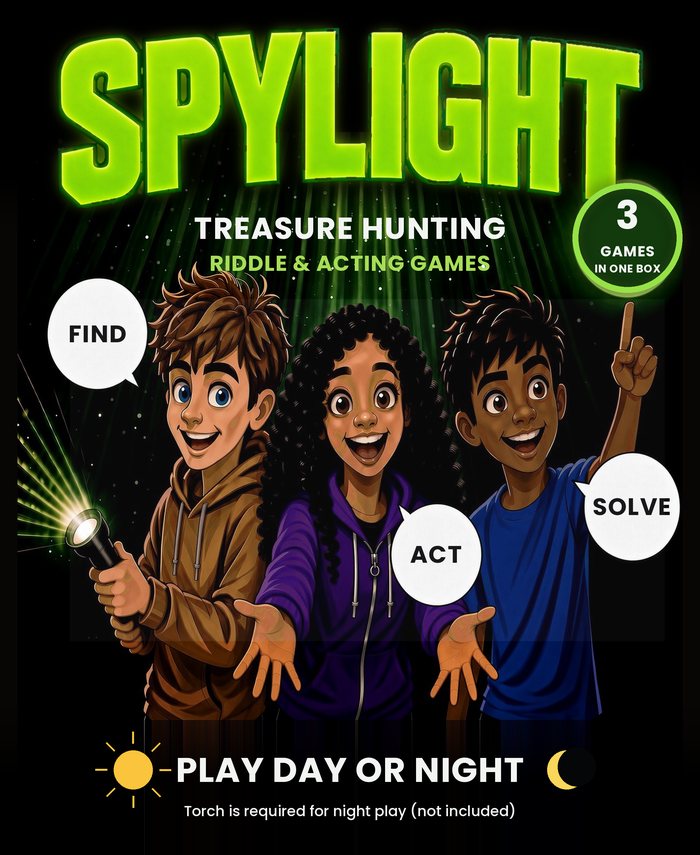
SPYLIGHT — a torch treasure hunt game for kids aged 5 to 12, played indoors or outdoors, day or night

The game you play

Day or Night

Turn any space into a treasure hunt — inside or out

Three children sweeping torch beams across a hedge in a dark back yard, searching for hidden cards.

Pick the cards to suitthe mood, the time, the space

Hide them and let the hunt begin — after dark, the monster’s eye catches your torch beam and flashes it straight back.

Launch priceNZ$39.95 Tell me when it’s ready →

Choose which twelve go out.

Twenty minutes before dinner. An afternoon at the campground. A birthday party that runs all evening once the performances start. A sleepover, a rainy day indoors. No screens, a quick hide, and no two hunts the same.

Every card brought home scores two points, with or without treats. What happens back at base is where the three kinds differ — and you decide how many of each go out.

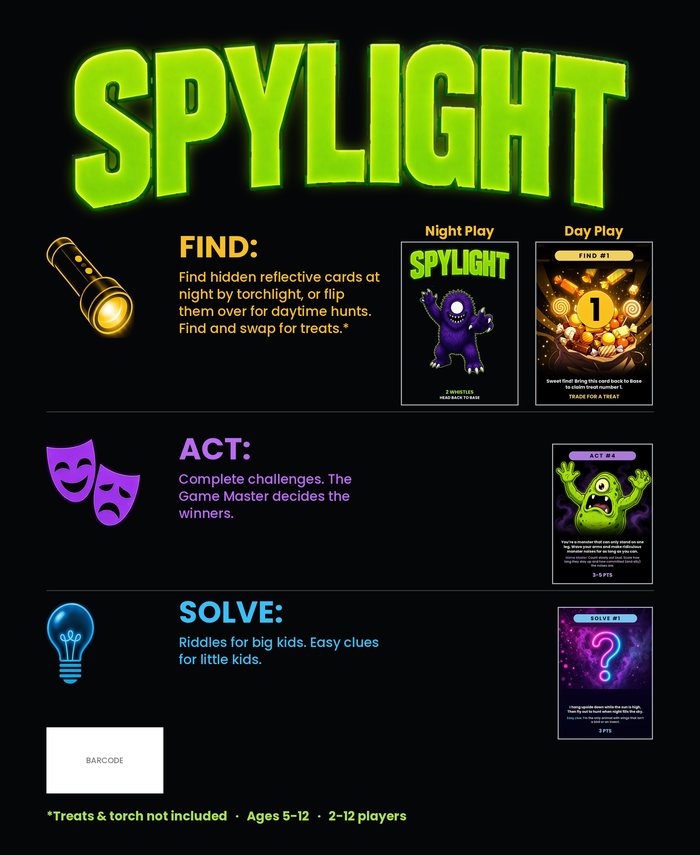
FIND cards

Hunt, then trade

The one to start with. Hide the cards, blow the whistle, and they’re gone. Every card that comes home scores two points, and can be traded for the treat with the matching number. No reading required. Treats are optional, though — plenty of players just play for points.

The back of a card: the cyclops, its eye throwing a torch beam back as a white flash. A Find card: bring it back and swap it for the treat with the matching number.

Cyclops side out in the holder for night hunts — that’s the side that flashes. Treat side out by day.

ACT cards

Hunt, then perform
Children balancing on one leg in a lounge while the Game Master holds up an Act card.

The one that gets them laughing. Every card is something daft to do — stand on one leg like a monster, roll across the floor with a giant chasing you, melt like an ice cream. Whoever found the card goes first, then the other team tries to outdo them.

An Act card: be a monster that can only stand on one leg, waving your arms and making ridiculous noises.

Send them out to find everything first, then score the performances back at base.

SOLVE cards

Hunt, then solve
Children sitting on a rug, one with a hand up, while the Game Master holds up a Solve card.

The one that rewards a good answer. A riddle on every card, worth the most if they get it first go. Whoever found the card gets first attempt — miss it and the next team gets a turn, with an easy clue in reserve.

A Solve card: a riddle about a tiny creature whose tail gives a glow in dark caves.

The easy clue means the little ones can play the same cards as the big kids.

Read the full rules

Spylight cards standing in clear holders on a table, with two torches beside them.

Torches are required for night play — not included. One per team is enough.

How it works

Slot the cards into their holders, hide them — then hunt them down by day or torchlight.

Each card slots into a clear holder so it stands up on its own — on a fence rail, in a garden bed, on a shelf in the hall. You can angle the eye to face wherever they’ll come searching from. Run it from base if you’d rather keep score — or hide the cards and go hunting with them. Your call.

The monster’s eye does the work. It throws a torch beam straight back the way it came, so the second a beam sweeps past, it flashes white — one bright spark in a dark hedge, half a garden away. A decent torch picks one out from a long way off. No batteries, no charging, nothing to switch on — it runs on your torch.

After dark

The eye side out

Torches on, lights off. The darker it gets, the better it works. Sends them to bed properly worn out.

In daylight

The picture side out

No torch, no dark, no waiting until bedtime. Turn the cards to the picture side and hunt them in daylight. Perfect for a birthday party.

In the box

Everything except the torches and the treats.

Made for backyards, parks, campgrounds and beaches — and all through the house.

  • 12 clear card holders
  • 54 cards — 12 Find, 20 Act, 20 Solve, 2 answer cards
  • Reflective dots — an eye for every card you hide
  • Score pad, pencil and whistle
  • Rules booklet

Torches and treats are not included. Night play needs at least one torch per team — any household torch will do. For the Find game you supply the treats to trade the cards in for. The dots fit once, before the first game — one on each card, giving the cyclops its eye. Five minutes, and it’s a job most children want to do themselves.

Launch price NZ$39.95

Shipping $9 flat anywhere in New Zealand

Designed in Christchurch, New Zealand. Non-toxic reflective dots; holders are moulded clear acrylic. Small parts — not for children under three.

Tell me when it’s ready →

When to play

There’s no board — play wherever you are.

Small back yards or wide-open parks. Inside or outside, day or night. Play Find on its own, or combine two or three. At Easter the eggs stay safe inside: the kids hunt for the numbered cards, then swap each one for its matching numbered egg. Nothing melts in the sun, the dog doesn’t find them first, and there’s nothing still lost in the grass in June. At Halloween the monsters are already on the cards, and a torch hunt in the dark beats knocking on doors.

Questions

The things parents ask.

How many kids can play?

Anywhere from two to twelve. Small groups play as individuals; bigger ones split into teams, however you want to divide them up. One adult runs it as Game Master.

Do I need a big backyard?

No. A small yard, a park, a campground or the inside of the house all work. For a short game you only need somewhere to hide a dozen cards where they can’t be seen from Base — and in a tighter space, just put fewer holders out. Six well-hidden cards in a small yard beats twelve obvious ones.

Can younger children play?

Yes. Find needs no reading at all, so five-year-olds manage happily, while Solve and Act give older kids more to chew on.

Can different aged kids play at the same time?

That is what it is built for. A six-year-old and a twelve-year-old play the same game, in the same garden, at the same time. Find needs no reading, and every Solve riddle carries an easy clue underneath, so a younger player can get there without being handed the answer. Nobody has to sit out or play a watered-down version.

How long does it take to set up?

A few minutes. You hide the holders, note where they went, and blow the whistle. The dots are fitted once, before the very first game, and stay put after that.

Why are there spare dots?

Mostly they’re replacements, but there are two good uses for them. If the hunt is proving too hard for a younger player, add a second dot to the cyclops’s hand — two reflective points are easier for a small child to catch in a beam. For a harder game, stick one on a scrap of paper or cardboard and hide it among the real ones as a false trail. It flashes exactly the same, and the groan is half the fun. Fitting is simple: press each dot over the centre of the white eye on the cyclops and it’s done — these are permanent adhesive, which is the same reason we ask you to keep them off the furniture and the reason they stay on a card. Spares only go on paper or cardboard you’re happy to throw away — never on furniture, walls or windows.

Is it easy to learn?

Yes. Hide the cards, blow the whistle, and the hunt is on — that is the whole of Find, and you can play it without reading anything first. Act and Solve add one rule each. An adult runs the game as Game Master, but the job is mostly counting points and calling everyone back to Base.

Does it work for Halloween?

It is probably the best night of the year for it. The monsters are already on the cards, the hunt happens in the dark by torchlight, and the treats are whatever you decide to put out. For a party, hide the holders around the house and garden before anyone arrives — it fills the stretch of evening that usually needs filling, and nobody has to knock on a stranger’s door.

Can you play it in daylight?

Yes, and plenty of families will play it that way most of the time. In daylight you turn the cards picture-side out for younger players, or cyclops-side out to make the hunt harder. No torch needed. The reflective eye is what makes the night version work, but it is not what makes the game work.

What if it rains?

Play indoors. Spread them through the house — bedrooms, under the table, behind the curtains, on top of the bookshelf.

Do I have to buy torches?

For night play, yes — but only one per team, and they’re not included. A team hunts together on a single beam, so most households already have enough. Any household torch works. A phone torch is fine up close, though a weaker beam won’t pick a card out from nearly as far. Daytime games need no torch at all.

Are the treats included?

No, you supply those. The Find cards are numbered so you can match each one to whatever treat you like — or skip treats entirely and just play for points.

Is it safe for little ones?

The reflective dots are small parts, so keep spares away from under-threes. Adult supervision is needed, particularly after dark, and the rules ask players to walk rather than run with a torch. One torch per team is the minimum, not a limit — hand out more if you want more light, whatever the age.

Where do you ship?

New Zealand, for the first run. If you’re elsewhere and want one, join the list and say so — enough interest and we’ll look at it.

Be first to know

Treasure hunting. Day or night.

Why I made it

I wanted to make a good old-fashioned treasure hunt. One where the younger kids weren’t at a disadvantage, and where mums and dads didn’t have to learn a million rules first.

There are very few games you can play after dark, and nothing beats the suspense of finding something by torchlight.

I think your kids will love playing it — whether they’re in it for the treasure hunt, the chance to muck about acting, or working out the riddles.

The first run is small. Sign up and you’ll hear the moment they land — at the launch price of NZ$39.95. Nothing else in your inbox — and you can drop off any time.

— David, Christchurch

Shipping $9 flat nationwide. We’ll only use your address to email you about Spylight — never sold, never passed on, unsubscribe any time. How we handle your data.

Thanks — you’re on the list.

Tell me when it’s ready